
Following a moment of quiet reflection, during which we all deeply appreciated the aroma and flavor of Mrs. Hudson’s raspberry scones, Dr. Kirk continued his story.
“I ended up informing Mr. Corrigan that I would spend the vacation between semesters in Cleveland. And I emphasized that he must abide by whatever I found, whether it be favorable to Dr. Sam – or otherwise.”
Holmes nodded his approval, once again hearing consistency with his own philosophy of objective investigation.
“On January 21, 1955, I boarded a plane for Cleveland and arrived on the morning of the 22nd. I met Corrigan at the hotel where he gave me copies of every photograph used by the prosecution during the trial and an armload of transcripts covering the prosecution’s case as presented to the jury. Corrigan told me very little. Ultimately the transcript told me much, but not until many hours of study. I spent the remainder of that day and evening sifting out pieces of testimony that I had to absorb before starting the investigation proper.
“As you can appreciate,” continued Kirk, nodding at Holmes, “my most critical task was taking detailed notes on the claims of the prosecution relating to the physical evidence.”
As Kirk pulled a sheaf of notes from his briefcase, I was surprised to see Holmes remove a small jotter from his vest pocket and begin flipping through the pages – obviously searching for a particular notation. Finally satisfied, he looked at Kirk and smiled thinly.
“Dr. Watson has informed me of the prosecution’s biased approach toward collecting and interpreting physical evidence, which I find appalling, yet many sources indicate that Sam Sheppard’s story was quite unbelievable. Can you illuminate this matter?”
“The first time I heard the story that Dr. Sam told immediately after the murder,” replied Kirk, “my impression – in two respects – was like that of many other persons. First, the story seemed not to make sense, and secondly, the circumstances were highly suspicious. It is probably still true that more people believe Sam Sheppard to be guilty because of his story than for any other single reason.
“Why an obviously intelligent person would tell so vague and indefinite a story was puzzling until it occurred to me that the reason must be that it was true,” Kirk continued. “Beyond a doubt, Dr. Sam knew that he would have to account for himself that night. Had he been making up a story, surely he could have done better!”
Holmes’ lifted one eyebrow at that remark.
“Let’s allow Sam Sheppard to speak for himself,” exclaimed Kirk. “With your permission, I will read you Dr. Sam’s sworn statement regarding the events of July 3rd and 4th, 1954. I believe it is crucial to understanding this case.”
Holmes nodded his assent and reclined on the sofa with his eyes closed and lips pursed upon tented fingertips. Familiar with my friend’s singular habits, I knew he would be absorbing every detail, even while he appeared to be dozing off.
I smiled reassuringly at Kirk, but he plunged right ahead, confident that Dr. Sam’s words would keep Holmes wide awake.
Kirk pushed up the bridge of his heavy, black-framed glasses with a forefinger and opened a binder filled with typed pages. Then he paused and looked sharply at Holmes.
“As you may know Mr. Holmes, Sam Sheppard first told this story in bare outline to Mayor Houk the morning of the murder. Except for minor details, his account of his actions and movements on that fatal night has never altered. Throughout his entire series of statements, only one fact was changed completely, and that was his initial denial of the affair with Susan Hayes.”
“Hmmm, yes,” mumbled Holmes, not bothering to open his eyes. “Misplaced chivalry I assume. Please continue.”
Dr. Kirk smiled indulgently at Holmes and continued speaking.
“Sam Sheppard gave the following statement to officers on July 10, 1954, in the sheriff’s office. It was later read into the trial testimony,” Kirk explained. He cleared his throat and began reading:
“‘After having a difficult morning and early afternoon at Bay View Hospital, where I am in charge of the accident room and the head of the Department of Neurosurgery, I made a couple of visits and then proceeded home. I arrived home at a time later than five o’clock, realizing this because I had hoped to work in the yard with my family and found that it was too late to do so. My wife informed me that we – correction – that she had planned to get together with Mr. and Mrs. Ahern that evening. We were to go to their home for a drink before dinner and then return to our home for dinner.’”
“Dr. Sam goes on to describe in great detail his family’s visit to the Aherns, his return to the hospital for an emergency call and the young patient’s broken femur,” Kirk summarized. “He also explains how he returned to the Ahern’s and how the four adults and their children moved to the Sheppard home for dinner.” Adjusting his glasses, Kirk took up reading Dr. Sam’s statement once again.
“‘At our home, Mr. Ahern and I chatted and the children played while the girls prepared dinner. The youngsters somehow evinced interest in my punching bag in the basement so I took them downstairs and placed a bushel basket under it so that they might reach the bag in order to hit it. I spent a moment or two with them showing them how it should be properly struck. I recall now that the children were fed in the kitchen before we ate. Shortly thereafter we four adults had dinner on the porch. It was quite breezy, the wind coming from the north generally, it may have been northeast or northwest but since the porch was cool, sweaters and jackets were in order and I put on my brown corduroy jacket. The others I am not sure of what they wore. I remember that my wife had baked pie, which is my favorite dessert. The other types of food I can’t truly remember. ’”
“Other than forgetting an entire dinner previous to pie, this is a man of many words and much extraneous detail,” remarked Holmes.
“Yes,” Kirk gave a short laugh, “he does come across as a pedantic bore in this interview. But I think he was desperately trying to piece this thing together, and his extreme attention to detail in the early part of his story is what makes the vague portion so believable. Obviously, he was very capable of fabricating a more acceptable, detailed story, if creating a cover up had been his intention.
“Anyway,” Kirk added, “Sam goes on to explain that the two couples decided to watch a movie, ‘Strange Holiday,’ on television.[1] In his sworn statement Dr. Sheppard relates how the children were put to bed, the dishes cleaned up, and he describes in minute detail where everybody was sitting as the television movie progressed.”
“‘My wife and I were sitting quite close in one chair, and that’s the last time I recall her in a relatively normal state, clearly. Mrs. Ahern seemed to be stimulated by our apparent affection, and she sat on Mr. Ahern’s lap for a short while.’”
“He then states that he became drowsy and moved to the day bed couch in the living room, which was situated against the west wall of the staircase leading to the second floor, and eventually fell asleep.” Kirk began reading again:
“‘The next thing that I recall very hazily, my wife partially awoke me in some manner and I think she notified me that she was going to bed. I evidently continued to sleep. The next thing I recall was hearing her cry out or scream. At this time I was on the couch. I think that she cried or screamed my name once or twice, during which time I ran upstairs, thinking that she might be having a reaction similar to convulsions that she had had in the early days of her pregnancy. I charged into our room and saw a form with a light garment, I believe. At that time grappling with something or someone. During this short period I could hear loud moans or groaning sounds and noises. I was struck down. It seems like I was hit from behind somehow, but had grappled this individual from in front or generally in front of me. I was apparently knocked out. The next thing I knew I was gathering my senses while coming to a sitting position next to the bed, my feet toward the hallway.
“‘In the dim light I began to come to my senses and recognized a slight reflection on a badge that I have on my wallet. I picked up the wallet and while putting it in my pocket, came to the realization that I had been struck and something was wrong. I looked at my wife, I believe I took her pulse and felt that she was gone. I believe that I thereafter instinctively or subconsciously ran into my youngster’s room next door and somehow determined that he was all right, I am not sure how I determined this.
“‘After that, I thought that I heard a noise downstairs, seemingly in the front eastern portion of the house. I went downstairs as rapidly as I could, coming down the west division of the steps, I rounded the L of the living room and went toward the dining table situated on the east wall of the long front room on the lake side. I then saw a form progressing rapidly somewhere between the front door toward the lake and the screen door, or possibly slightly beyond the screen door. I pursued this form through the front door, over the porch and out the screen door, all of the doors were evidently open, down the steps to the beach house landing and then on down the steps to the beach, where I lunged or jumped and grasped him in some manner from the back, either body or leg, it was something solid. However, I am not sure. This was beyond the steps an unknown distance but probably about ten feet. I had the feeling of twisting or choking and this terminated my consciousness.
“‘The next thing I knew I came to a very groggy recollection of being at the water’s edge on my face, being wallowed back and forth by the waves. My head was toward the bank, my legs and feet were toward the water. I staggered to my feet and came slowly to some sort of sense. I don’t know how long it took but I staggered up the stairs toward the house and at some time came to the realization that something was wrong and that my wife had been injured. I went back upstairs and looked at my wife and felt her and checked her pulse on her neck and determined or thought that she was gone. I became or thought that I was disoriented and the victim of a bizarre dream and I believe I paced in and out of the room and possibly into one of the other rooms. I may have re-examined her, finally realizing that this was true.
“‘I went downstairs. I believe I went through the kitchen into my study, searching for a name, a number or what to do. A number came to me and I called, believing that this number was Mr. Houk’s. I don’t remember what I said to Mr. Houk. He and his wife arrived there shortly thereafter. During this period I paced back and forth somewhere in the house, relatively disoriented, not knowing what to do or where to turn. I think that I was seated at the kitchen table with my head on the table when they arrived but I may have gone into the den. I went into the den as I recall, either before or shortly after they arrived. The injury to my neck is the only severe pain that I can recall. I should say, the discomfort in my neck. I didn’t touch the back door on the road side to my recollection.’”
Clarifying the home’s layout and players in this story, Dr. Kirk explained, “The family considered the front of the home to face the lake; thus the back door faced the road. J. Spencer Houk was the mayor of Bay Village and a neighbor. He and his wife Esther were social friends and shared ownership of an aluminum boat with Sam and Marilyn. They and their two teen-age children lived a few doors west of the Sheppard family. Sam and Marilyn’s son, Chip, was only 7 years old.”
Kirk added, “Although Sam was unable to recreate his early-morning telephone conversation with Houk in his statement to the sheriff, both men agreed in trial testimony that Sam said:
“‘My God, Spence, get over here quick. I think they’ve killed Marilyn. Get over here quick.’”
“Hmmm, I seem to remember . . . ,” I said, thumbing through my notes, “yes, here it is. Dr. Les Hoversten — an osteopathic physician and friend of Dr. Sam’s – had been staying with Sam and Marilyn for several days. Out of town with friends in Kent, Ohio, on the night of the murder, he visited Sam soon thereafter at Bay View Hospital. His court testimony described his conversation with Sam during that visit:
“‘I walked up to his bed, and, as I recall correctly, I took his hand, and Dr. Sam started to cry, and I remember he said, ‘My God, I wish they’d killed me instead of Marilyn. Chip needs Marilyn more as a mother than he does me.’”
“Once again, you see,” I said, “Sam referred to the killer as ‘they.’”
“An interesting point, Watson,” commented Holmes.
Dr. Kirk acknowledged my contribution, cleared his throat and resumed his narration.
“In response to Dr. Sam’s phone call, Spencer and Esther dressed and drove their car over to the Sheppard home. Mr. Houk called the ambulance and Dr. Sam’s two physician brothers, Dr. Richard and Dr. Steve. On arriving, Dr. Steve found Sam injured and transported him in his private car to nearby Bay View Hospital. Dr. Sam was questioned extensively that morning and afternoon at the hospital by Cuyahoga County Coroner Samuel Gerber and Cleveland Police officers. The officers showed Sam the green cloth bag that Mayor Houk’s son, Larry, had found in the bushes behind the house and asked Sam why his watch was in that bag with blood on the band and moisture under the crystal. They questioned him at length about his home life and relationship with his wife. And they spent considerable time probing into his alleged affair with Susan Hayes – a former nurse at Bay View Hospital who had moved to California years ago. Sam denied the affair.”
“And you believe his story for the very fact of its vague and indefinite nature?” Holmes probed of Kirk.
“That, and the fact that all his statements regarding what he actually remembered can be verified,” said Kirk. Producing a red pencil and his typed copy of Sam’s statement, he circled and numbered parts of the sworn statement as he spoke.
“Point One: All the early evening events of Saturday, July 3rd, were readily verified by witnesses, and everyone agreed that the Aherns left shortly after midnight.
“Point Two: I conducted an experiment in the home near midnight under conditions similar to those on the night of the murder. That is, the lamp just outside the bedroom door was turned on low, and all other lights in the house were off. Dr. Sam’s eldest brother Dr. Richard Sheppard – dressed in a white shirt and dark slacks – took the position of the murderer beside the bed. Downstairs in the dark, I stretched out on the couch and closed my eyes for a period of time. Suddenly, I jumped up, ran up the dark stairway, and entered the bedroom. I saw exactly what Dr. Sam described: a whitish form, essentially shapeless. This experiment was repeated with variations, but the results were basically the same. The white shirt reflected just enough light to be distinguishable as a blurred area. The dark slacks could not be seen at all, nor could the form itself be recognized as a person clothed in a white shirt.
“Point Three. Although Sam’s statement about seeing a reflection of light from a badge, picking up his wallet and putting it in his pocket cannot be checked, the fact that the wallet was soaking wet when handed over to the police proves it was on his person while he was in the lake.
“Point Four. The matter of Sam’s having been knocked unconscious as he entered the bedroom and again on the beach is confirmed only by the fact that his injuries were compatible with the kinds of blows required to produce unconsciousness.
“Point Five. Several factors wholly confirm that Sam was lying in the lake. A partial record of his movements after coming from the lake was indicated by water on the steps at the beach, as well as water puddled outside the lake-front porch. This evidence was documented by the first Bay Police officer to come on the scene at 6:10 A.M. Quantities of sand found in the toes of Sam’s shoes and his trouser pockets further confirm that he was lying in the water as he described.
“Point Six. Dr. Sam’s second visit to the bedroom is also clearly recorded. The diluted blood on the left knee of his trousers, and its counterpart on the bed sheet – along with his left thumb print, which was ten inches from the side of the headboard – give indisputable proof of this part of his story.
“Finally, the one statement that proved to be untrue was his initial claim of a platonic-only relationship with Susan Hayes. That this was a deliberate lie on Sam’s part is assumed since he withdrew the statement as soon as Miss Hayes admitted the affair. Misplaced chivalry indeed.”
“Quite so,” I inserted vehemently. “It has been said that Sam Sheppard was tried for murder but convicted of adultery.”
“That he was guilty of adultery was certainly a major factor in the outcome of this trial,” confirmed Kirk. “All parties agree that his conviction was based completely on circumstantial evidence, and the critical circumstance was the fact that Sam Sheppard, the victim’s husband, was in the house at the time of the murder. According to the prosecution, investigators found no evidence of forced entry into the home.”
I felt a surge of frustration well up in my chest. I am a bit embarrassed to report that I leapt from my chair, upsetting it in the process, and practically threw myself between my two startled companions
“But sir,” I exclaimed, “You must know that on July 23, 1954, Cleveland Detective Henry Dombrowski did find evidence of forced entry into the basement of the Sheppard home!”
Kirk frowned and pulled off his glasses as he replied, “In the 1950s, Dr. Watson, the police and prosecutors were not required to open their files to the defense. Cleveland’s Scientific Investigation Unit worked to find evidence that could be used to convict Sam Sheppard; the police had no obligation to reveal evidence that pointed in the opposite direction.”
“And so, my dear Watson,” said Holmes, extracting a cigarette from his worn silver case, “when was Detective Dombrowski’s report finally revealed, and what, exactly, did it say?”
Having up righted my poor chair, I was sitting calmly once again and took this opportunity to demonstrate my extensive reading and research.
“Forty years after Sheppard’s conviction,” I said, “Samuel Reese Sheppard, Dr. Sam’s son, and a team of pro bono investigators discovered Dombrowki’s report, hidden away in the files of the Cleveland Police Department. Young Sam and investigative reporter Cynthia Cooper reproduced Dombrowski’s full report in their 1995 book, Mockery of Justice, and I have a copy, right here. I will read what the Cleveland detective reported in 1954:
“‘A plasticine impression was made of what appears to be a freshly made tool mark in a door at the foot of the basement stairs. This door leads to a crawl space at the front of the house. Mark appears to have been made by a chisel or wedge-like tool of more than 7/8” in width which is the length of the impression, however this does not show both edges of the tool.”
“Now Watson, please explain,” demanded Holmes — ever the careful listener, “how does a door at the foot of the basement stairs and leading to a crawl space give access to the house from the outside?”
“Confusing at first glance,” I answered with a knowing smile, “the lake side of the house, always referred to as ‘the front’ of the house, featured a cellar door that opened to reveal six steps leading down to a crawl space. A door at the end of the crawl space gave access into the basement of the home. Detective Dombrowski found the tool mark on the outside of this second door. That door opened at the foot of the basement stairs, which led up to the kitchen.”
“Astounding!” cried Holmes. “A crucial piece of physical evidence buried by the police for forty years.”
“Detective Dombrowski’s finding means that the murderer could have broken into the house through the basement and headed upstairs to the kitchen,” Kirk reasoned. “Alternatively, he or she simply could have waltzed into the house from the back door on the Lake Road side of the house. The Sheppards, like many suburban dwellers in the fifties, rarely locked their doors.”
“Either way, the murderer had easy access to the second floor through the kitchen, which makes sense only if you understand the layout of the house,” said Kirk as he pulled several drawings and photos out of his briefcase and laid them on the table in front of us, including this sketch of the first-floor layout of the Sheppard home.
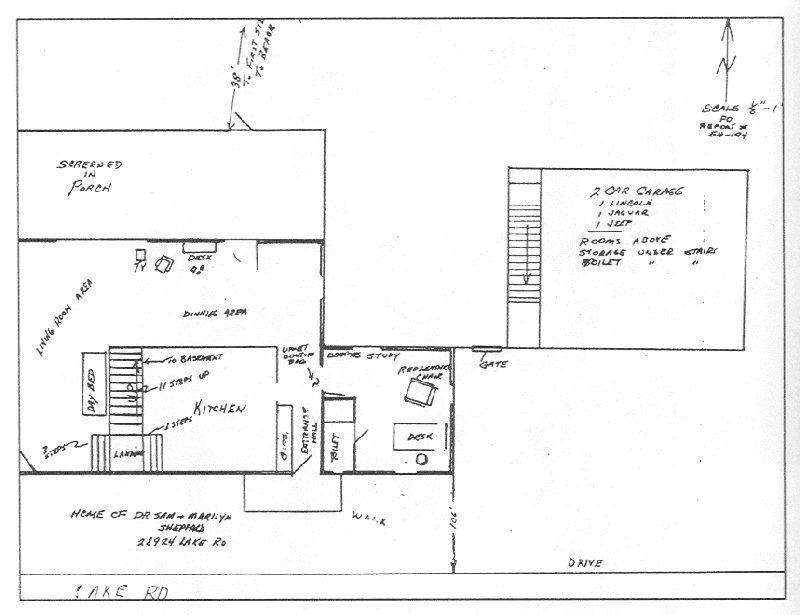
Using his pen, Dr. Kirk directed our attention to the kitchen and the double landing for the stairway to the second floor.
“Dr. Sam fell asleep on the day bed located in the living room, next to the wall enclosing the stairwell. This double landing gave access to the stairway and the second floor from both the living room and the kitchen. You can also see an arrow pointing to the location of the door to the basement on the west wall of the kitchen under the stairway.”
“A unique arrangement, indeed,” Holmes mused as he examined Kirk’s sketch. “This stairway to the second floor is remarkably unexpected in its location. Finding it easily in the dark would require familiarity with the home.”
“Yes, and these police photos confirm that conclusion,” continued Dr. Kirk. “This first photo shows the day bed and the foot of the stairway leading to the second floor from the living room. And in this next photo, we see the foot of the same stairway accessed from the kitchen. Unless the intruder knew about the stairway from the kitchen, he would have run right into Sam Sheppard asleep in the living room.”
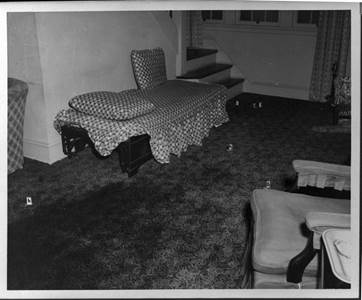
Police photo of the daybed and stairway leading to the second floor from the living room
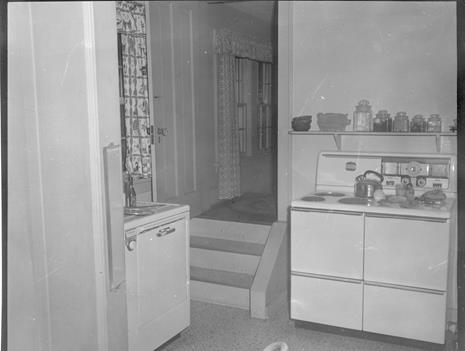
Police photo of the stairway leading to the second floor from the kitchen
Holmes peered intently through his magnifying glass at the kitchen photograph. Suddenly, he looked up and proclaimed, “The Sheppards had neighbors and their children over for dinner, and yet this kitchen is tidy, organized and immaculate. That tells us a great deal about Mrs. Marilyn Sheppard. Please make a note of this Watson.”
That certainly was not the conclusion I expected, but I did jot down “tidy, organized and immaculate” in my pocket jotter.
“Now, Watson,” said Holmes, pouring himself another cup of tea, “you mention the book written by Cooper and Sam Reese Sheppard. I assume that a book written by Sheppard’s son would focus on a suspect other than Dr. Sam Sheppard. Is that correct?”
“Right you are. With the assistance of a private investigative agency, young Sam and Miss Cooper not only uncovered repressed evidence, they also documented forensic evidence and interviews with new witnesses that incriminated Richard Eberling, a handyman and window washer hired by many Bay Village families.”
Dr. Kirk, obviously aware of Richard Eberling as a tardy suspect in this case, added, “ignored by police in 1954, Eberling was arrested for larceny in November 1959. His loot included two diamond rings that had belonged to Mrs. Marilyn Sheppard. This time Bay Village police did question him about Mrs. Sheppard’s murder. He said he stole the rings in March 1958 from a box labeled, ‘Marilyn Reese Sheppard personal property,’ that he found while working at Dr. Richard Sheppard’s home.”
“And what happened?”
“Eberling got Chief of Police Eaton’s attention when he volunteered to explain why his blood was in the home and showed him the scar on his left hand. Chief Eaton tried to arrange an expert polygraph test, but Coroner Sam Gerber blocked it, saying he didn’t think Eberling was involved in the murder.”
Of course, I knew about all the unconscionable efforts to convict one chosen suspect in this case, but Holmes, still believing in a logical investigative process, asked “So what suspects, other than Sam Sheppard, were considered?”
“No other suspects were seriously considered in 1954,” said Kirk. Hearing this, Holmes reared back in his seat, speechless — a first for Sherlock Holmes.
“However,” I hastened to add, “over the years several other suspects have been proposed – and that is exactly what I hope this collaboration can sort out.”
Holmes silently slid a small notebook from his jacket pocket. I knew what he wanted, and I had those details from my research. “In 1966 Dr. Sam’s lawyer, F. Lee Bailey, pointed a finger at the Houks – Esther, Spencer and son Larry Houk – in a 12-page letter he submitted to Bay Village chief of police Fred Drenkhan. As already mentioned, a great deal of evidence was compiled against Richard Eberling and published in 1995. Another entire book, Tailspin – written by Bernard F. Conners and published in 2002 — presented compelling evidence against Major James Arlon Call.” “And Holmes,” I added with intent, “the murder of Mrs. Marilyn Sheppard remains open and unsolved.”
[1] Watson and Kirk thoroughly versed Holmes on all references to 20th and 21st century items such as television, aluminum, computers and the like. Surely there is no need to elaborate on those explanations for 21st-century readers.
