
Holmes began pacing back and forth between the serving table and the window, thumbing through his notebook and saying not a word. Finally, he returned to the sofa, reclined lengthwise along its entire surface and motioned for us to join him in nearby chairs. He obviously had come to some kind of important decision, but what?
“In reading about this case, Dr. Kirk, I find it strange that the coroner positively identified the murder weapon as a surgical instrument. His testimony certainly influenced the jury against Dr. Sheppard, and yet he could never produce such an instrument. Upon what physical evidence did he base that damning conclusion?”
“Ahhh, yes, the surgical instrument. That was one of my first questions as well. Like you, Mr. Holmes, I learned long ago that in every investigation, alternate and opposing theories regarding what took place are always present. In the end, however, the correct theory must either explain, or be consistent with, every known fact. Any theory that is contradicted by a proven fact must be incorrect!”
“Most assuredly!” agreed Holmes with a careful smile.
Warming to his subject, Kirk continued, “The prosecution’s theory about the Sheppard case was available in the transcript, along with a lengthy recital of the facts and details on which their concept of the case was based,” Kirk explained. “According to the court transcript, we know that Coroner Gerber examined the bed after Mrs. Sheppard’s body had been removed and discovered what he described as an ‘impression of a two-bladed instrument’ on the underside of the pillow. It consisted of two crescent-shaped deposits of blood – mirror images of each other – that suggested curved jaws of some sort of instrument. Both ends were jagged, which gave the appearance of teeth.”
He interrupted his story to hand Holmes a photograph of the bloody imprint that Dr. Gerber found on the pillow.
“Look closely inside the large patch of blood on the right” directed Kirk, “and you will see Gerber’s so-called surgical instrument.”
Holmes examined the photo and then grabbed his magnifying glass and inspected it again. He handed the glass to me. Ignoring the bloody imprint with the jagged edge, I stared into the rounded imprint beside it. There I saw what looked like two prongs with lesser points beneath each prong, and the whole curving toward each other like the two sides of a horseshoe. Even though I had seen this image before, I felt the breath catch in my chest.
“It’s like a window into the murder,” I whispered.
“That imprint begs for identification, no doubt about that,” Holmes declared.
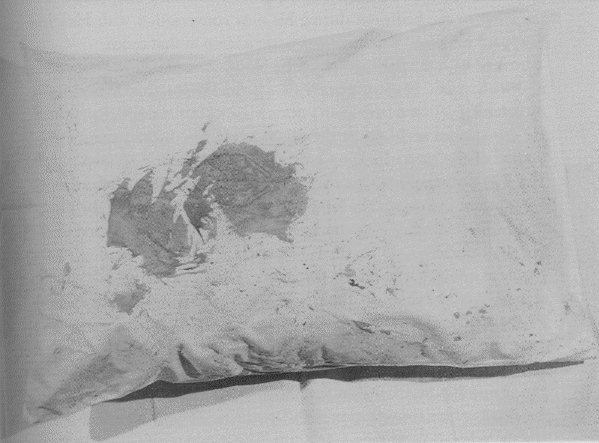
“During the trial,” Kirk added, “this photograph was shown to the jury. I’ll read you Gerber’s sworn testimony with respect to the blood stain:
“‘Gerber: They took their pictures (the police), then I turned over the pillow that was at the head of the bed and found a blood stain on the opposite side of the pillow, a large blood stain.
‘Prosecutor: And what else?
‘Gerber: And on that pillow was the impression of an instrument.
‘Prosecutor: And what type of instrument?
‘Gerber: The type – a surgical instrument.’”
“Of course, Gerber’s concept of the murder weapon could never be confirmed,” explained Kirk, “because no surgical instrument corresponding to his description could be found in any hospital or surgical supply house in the country. And according to later testimony, the size and shape of this so-called ‘surgical instrument’ made it entirely inadequate as a murder weapon. Finally, my own examination of the blood spatter on the pillowcase revealed that the side opposite to the alleged instrument mark was upward during the beating.”
“Computer enhancement of the bloody imprint was conducted in 1982,” I added, placing the enhanced image next to the original police photograph.
I admit to a twinge of pride as I realized that neither Dr. Kirk nor Holmes knew about this additional piece of information. And I felt absolutely smug as I brought them up-to-date on modern computers. Referring to the 1982 report by James Ebert, I explained how computer enhancement was carried out:
“After subjecting the photograph to contrast enhancement, edge enhancement and density slicing, Ebert concluded that the imprint was most likely made by a ‘single, curved instrument that was creased between two layers of bloodstained cloth and thus made mirror-like image imprints on each side of the crease.’[1] The fold or crease in the pillowcase extended directly through the central axis of the so-called instrument, as you can clearly see.”
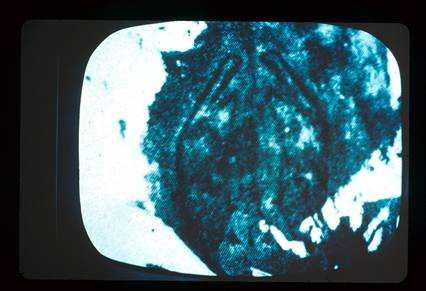
“Okay,” said Holmes, “It may have been a mirror-image of a single curved object. But what was the object?”
I had put a lot of thought into that very question. “My research shows that a standard pillowcase in the United States during the 1950s measured about 29 inches in length and 18 ½ inches wide. Using that known dimension, this curved object would have been about 6 inches in length. However, please note my friends, this 6-inch object might have been just the end of a longer tool.”
“On the other hand,” responded Dr. Kirk, “my laboratory experiments proved that when blood runs into folds of cloth and dries, it can produce the mirror-image and ‘toothed’ effect observed by Dr. Gerber. Is this an imprint of the murder weapon . . . or something else? Unless this object is found, we will never know for certain if this is the imprint of a double-armed tool, a mirror image of a single curved instrument or a collection of blood within folds of cloth.
“But we do know for certain,” continued Dr. Kirk, “that the nature of an unknown weapon that has inflicted injuries can be deduced from two types of information: 1) that obtained from studying the wounds, which reflect the shape and character of the object that made them, and 2) reconstruction of the physical aspects of the crime. The latter will eliminate some types of weapons but will not exclude others.”
Holmes and I listened intently as Dr. Kirk elaborated on his findings and conclusions regarding the murder weapon.
“Examination of Mrs. Sheppard’s wounds, accurately recorded in photographs and re-created in a three-dimensional death mask, showed 27 blows to the forehead and scalp. The nature of the wounds revealed that the weapon had a blunt edge, which produced lacerations and tore tissue, but did not cut cleanly. A few injuries were crescentic, or half-moon shaped, indicating that the weapon was cylindrical.
“Based on the pattern of blood deposited on the bed and every wall of the murder room, we know where the victim’s head rested in relation to the murderer’s position. When the end of the weapon in the murderer’s hand struck her head, the distance between the killer’s hand and her head was the weapon’s length. Given allowances for variation in the length of men’s arms and their heights, it can be concluded that the weapon was not over one foot in length. It is also clear, and I will explain this in more detail later, that the victim was unconscious and unable to call for help during the majority of the beating.
“Furthermore, we know that Dr. Adelson – chief pathologist for Coroner Gerber – testified that although the skull was fractured into many pieces, none of the bone was driven into the brain, nor was the dura (the tough covering over the brain) penetrated. This information proved that the weapon was not heavy. Although the extent of damage depends on the force used, as well as the weight of the weapon, it is difficult to produce deep wounds with a light instrument.”
“What do you make of that, Watson?” exclaimed Holmes, peering at me with his typical inscrutable intensity. “Why would the coroner risk his professional reputation and make such an unsubstantiated statement – identifying the weapon as a surgical instrument and totally disregarding the evidence presented by the wounds and physical distribution of blood spatter?”
I knew Holmes already had his own theory in answer to that question, but as was his custom, he invited me to develop my powers of deduction before revealing his own brilliant conclusions. I say that with all fondness, and this time I was more than ready.
“I’ve been doing a bit of research on that very question, my dear fellow. Newspaper archives and transcriptions of later interviews,[2] including several with Cleveland Press reporter Doris O’Donnell, who covered the 1954 trial, reveal that Coroner Gerber had a history of leveling unfounded accusations at the Sheppard family. As far back as 1938, the freshly elected coroner tried to implicate Dr. Sam’s father – Dr. Richard A. Sheppard — and Sheppard’s Cleveland Osteopathic Hospital in a series of unexplained murders of indigents and transients that took place in Cleveland during the late 1930s.”
“Good God, Dr. Watson!” exclaimed Kirk. “Are you saying Gerber tried to implicate the senior Sheppard in the Torso Murders?”
“Indirectly, yes. You obviously know that all the victims in these macabre murders had been killed with no sign of struggle, just cleanly and carefully dismembered — thus the name. Our Coroner Gerber suspected the perpetrator was medically trained or knowledgeable with anatomy. He was actually quoted in a 1938 daily newspaper, suggesting that the murderer was likely a butcher, hunter, chiropractor or osteopath.”[3]
“Quite a revealing statement,” murmured Holmes.
“When interviewed, Cleveland Press reporter O’Donnell spoke at length about Gerber’s Inner Circle. It included several reporters, Cleveland police officers and the Cuyahoga County sheriff. Evidently this group met frequently to discuss theories and suspects on current cases. According to O’Donnell, Gerber suspected that an orderly or some other medically trained person at the Cleveland Osteopathic Hospital was connected with the Torso murders.
“She said Gerber went so far as to order a crew to dig up the back yard of Sheppard’s Osteopathic Hospital and search for body parts. When that failed, Gerber claimed that Dr. Richard A. Sheppard was performing illegal abortions and searched the hospital yard for buried fetuses. He never found anything, and charges were never filed, but Gerber never forgot. His negative feelings toward the Sheppard family physicians and the osteopathic profession in general were in evidence as far back as the 1930s.”
Holmes sat in stony silence, staring intently at the far corner of the room, an index finger to his lips. I was turning round to see what so held his attention, when he suddenly stood up, pursed his lips and pointed a bony finger in my direction.
“Now, Watson, you graduated from the University of London as an M.D. in 1878. You began talking about Andrew Still and his principles of osteopathy in 1885, and you once said that you admired many of Still’s ideas. If an M.D. could find concepts to admire, disdain for osteopathy, alone, cannot account for Gerber’s extreme prejudice against the elder Sheppard and, subsequently, his son.”
“Hmmm. I see your point, Holmes,” I replied as I thumbed through one of my well-worn texts. “Andrew Still began his medical career as I did, as an M.D., treating patients with methods commonly used and recommended in medical books of the 1800s — bleeding, blistering, purging and administering harsh and even toxic pharmaceuticals.
“You’ll remember how I questioned many of those methods myself, Holmes!” I looked to my colleague for confirmation, but finding none, I continued my recitation.
“Traditional medicine failed Andrew Still. His first wife died in childbirth, he lost three children to spinal meningitis, and another died from pneumonia. He rejected medical teachings of the time and immersed himself in a study of human anatomy. He decided that the body could heal itself, without drugs, if proper anatomical alignment allowed blood and what he called ‘nerve force’ to flow freely through the body.”
“Dr. Sam’s father, Richard Sheppard, decided to study osteopathy for a similar reason,” added Kirk. “His young sister, Pauline, suffered from rheumatic heart disease, and conventional medicine offered no treatment. Seeking a better way to cure people, he enrolled in Still’s Osteopathic Medical School in Kirksville, Missouri, and graduated as a Doctor of Osteopathy (D.O.) in 1911. Richard Sheppard began practicing medicine in several small towns in northern Ohio, was elected Wyandot County coroner in 1920, and joined the Roscoe Osteopathic Clinic in Cleveland in 1923.”
Taking note of that date, I again referred to my research notes. “Sam Gerber graduated from Cincinnati Eclectic Medical College in 1922. Interestingly, early eclectic medicine made use of botanical remedies and physical therapy, and eclectic doctors (like osteopaths) opposed the techniques of bleeding, chemical purging and the use of mercury compounds. However, after World War I and by the time Gerber matriculated, the eclectic college had been forced to teach students about pharmaceutical medicines to gain American Medical Association accreditation.”
I paused, wondering about the parallel tracks of Richard Sheppard and Sam Gerber. When did they first meet? And what happened to cause Gerber’s extreme animosity? I pulled out another pile of notes and plunged ahead.
“The young Sam Gerber, M.D., launched both his medical practice and his political career in Scott, Ohio, where he had a private practice and was elected mayor. He relocated to Cleveland in 1925 and maintained a private practice while working for the city’s Department of Health and Welfare – all the while keeping his political aspirations alive.”
Now it was Dr. Kirk’s turn. He knew the history as one who had given the situation a great deal of thought. He spoke with passion, and he brandished a well-worn newsletter, The Buckeye Osteopath.
“Pioneering osteopaths, of which Richard Sheppard was one, faced serious discrimination and even prosecution as they tried to establish a new health-care profession that focused on the whole person instead of treating just symptoms,” declared Kirk. “The American Medical Association and the M.D. community fought hard to prevent the recognition and licensure of osteopathic physicians. They did not welcome competition from D.O.s, and denigrated Still’s drug-free approach to healing. It wasn’t until 1902 that state law allowed certified physicians to practice osteopathy in the state of Ohio, but D.O.s were not allowed to administer drugs nor to perform major surgery. And, most significantly, osteopathic physicians in Ohio were not given access to any allopathic (M.D.) hospitals.”
Reading from the faded 1923 copy of The Buckeye Osteopath, Dr. Kirk shared more details, “As the new president of the Ohio Society of Osteopathic Physicians and Surgeons in 1923, Richard A. Sheppard urged his colleagues to ‘establish Osteopathic Dispensaries in each district of the state where those who have little or no means can obtain osteopathic service free or according to their means. To do this successfully it will be necessary for each of us to contribute both of his time and substance for the good of the cause.’ [4]
“Not only did the elder Sheppard work tirelessly to bring hands-on healing to the people of Ohio,” explained Kirk, “he also took the lead in establishing a hospital in Cleveland where osteopaths could treat their patients.”
I became as passionate as Dr. Kirk, brandishing my stack of research notes and taking up where Kirk left off.
“Sam Gerber, as we know,” I emphasized, “publicly disparaged osteopaths in the newspaper and likely worked against them every chance he got. While Richard Sheppard, D.O., was striving to establish free osteopathic dispensaries throughout the state of Ohio to gain recognition for his profession, Sam Gerber, M.D., was practicing medicine privately and working for the city of Cleveland as physician for the Warrensville Workhouse, the city’s parochial schools and the Wayfarers Lodge – a shelter for homeless men and boys.
“Furthermore, I found that Gerber first ran for Cuyahoga County Coroner in 1934. Although he lost that first election, he won in 1936, forever closed his private medical practice and found a ready-made route to public fame and admiration via his well-publicized efforts to solve the Torso Murders. He grew his power as county coroner over the next 12 consecutive elections.”
“And right in the middle of Gerber’s fevered attempts to solve the Torso Murders,” said Dr. Kirk, waving a slim history book[5] on osteopathic medicine in Ohio, “a group of osteopathic physicians, led by Dr. Richard A. Sheppard, purchased and renovated a three-story mansion at 3146 Euclid Avenue in downtown Cleveland. They opened Cleveland Osteopathic Hospital as a nonprofit institution in September 1935. As the osteopathic profession grew in Ohio, additional facilities were needed, and Sheppard spearheaded a fundraising campaign to purchase the Lawrence Mansion in Bay Village on the west side of Cleveland. The 24-room mansion was remodeled and dedicated as a second osteopathic hospital on October 3, 1948.”
“So, by July 1954,” I added, eager to build on Kirk’s historical account, “Gerber knows that the osteopathic profession is thriving, thanks in part to Richard Sheppard’s successful Bay View Hospital. And Gerber – up for re-election once again — craves public attention and glorification for solving yet another sensational crime. He already harbors suspicion and jealousy for the Sheppard clan, so he makes a desperate bid for both revenge and publicity with his unfounded conclusion that Sam Sheppard killed his wife with a surgical instrument.”
Quite pleased with my analysis of the situation, I was surprised to notice Dr. Kirk and Holmes glancing at one another with raised eyebrows.
“A bit premature, my dear Watson,” countered Holmes, shooting a quick smile in my direction. “I believe Gerber’s actions in this case go even deeper than professional jealously and political ambition. Let’s address that again later.
“In the meantime, I must ask you, Dr. Kirk, given that our work is based upon the inviolate principle that the correct theory in reconstructing a murder must explain or be consistent with every known fact, what does this bloody imprint tell us about who murdered Marilyn Sheppard?”
Unfazed, Kirk replied, “The bloody imprint on the pillow is a red herring, Mr. Holmes. It tells us nothing about the murderer. But the distribution of blood on the walls and furniture in the murder room tells us everything.”
Appearing unsettled with Kirk’s reply, Holmes stood and strode quickly across the room. At the door, he paused and faced us. “You have piqued my interest in this case, for certain, Drs. Kirk and Watson. I have an appointment up town which I must keep, but I shall return in three hours.” And with that, Sherlock Holmes opened the door and left us sitting in the flat with nothing to do but ring for Mrs. Hudson and ask that good woman to begin preparations for dinner.
[1] James I. Ebert, Certified Photogrammetrist, ASP, report: “On January 3, 1982, an 8” x 10” halftone-screened photograph of a blood-stained pillowcase marked ‘State’s Exhibit 34’ was examined for Prof. James W. Chapman, using the Digicol system.”
[2] Personal interviews with a number of key persons were conducted in 1981 and 1982 by Duvall, Dalrymple and Chapman. The interviews were tape recorded with full knowledge of all parties and later transcribed.
[3] Davis, Dave. “Weekly photo flashback: the Torso Murders of the 1930s.” The Plain Dealer, November 4, 2009.
[4] Sheppard, Richard A., D.O., “President’s Message,” The Buckeye Osteopath, Vol. 1, No.2, Dayton, Ohio, August 1923.
[5] Miller, Carol Poh, A Second Voice, A Century of Osteopathic Medicine in Ohio, Ohio University Press, Athens, Ohio, 2004, pp 27 – 28.
Discover more from The Sheppard Chronicles
Subscribe to get the latest posts sent to your email.
