
I had never seen Holmes quite so furious. He lunged across the reading table, grabbed two sheets of paper covered with his precise scrawl and strode over to a bookcase. Using tacks, he hung both sheets from the shelf, making their contents visible to Dr. Kirk and myself. He then whirled to face us.
“Last night, during my visit to the library, I wrote out two lists. You see them before you. List One summarizes the evidence used by the prosecution to convict Sam Sheppard. List Two outlines the evidence ignored or considered irrelevant by the prosecution, and this second list, my friends, strongly points to the actual murderers!”
List 1: Evidence Used Against Sam Sheppard
- He was present in the house
- No sign of forcible entry
- Extramarital affair with Susan Hayes (which he lied about)
- Sam’s story was wild and unbelievable
- His injuries were thought to be self-inflicted
- The family dog did not bark
- Fingerprints were wiped clean from Sam’s desk, it was claimed that Sam had done so.
- His T-shirt was missing. It was claimed that the loss indicated he used it for washing off blood spatter, and later either destroyed it or lost it.
- The condition of the corduroy jacket seemed to be inconsistent with his account of the events of the night. When first noted by the police, it was neatly folded at the northerly end of the couch.
- His head and neck injuries led to an immediate and natural suspicion that he received them during the death struggle with his wife.
- The murderer had clumsily faked a burglary – possibly a natural thing for a guilty husband to have done in an attempt to divert suspicion. Finding his watch in the discarded green bag – with water under the crystal and blood on the exterior – contributed to the likelihood that he had committed the so-called burglary.
- Imprint on the pillow of a surgical instrument as murder weapon (1954 criminal trial)
- Imprint on the pillow of a lamp harp as murder weapon (2000 civil trial)
List 2: Evidence Ignored or Considered Insignificant by Cleveland Authorities.
- Sam Sheppard had only one spot of blood on his clothing
- Two of Marilyn Sheppard’s teeth were found broken off and outside of her mouth, broken in a manner that suggested she had fought for her life and bitten her assailant. Sam Sheppard had no open or bleeding wounds.
- Mary Cowan’s microscopic examination of scrapings taken from under Marilyn Sheppard’s fingernails revealed dried blood; red flakes of paint (so-called nail polish); a brown plant fiber; a red wool fiber; a dark blue wool fiber; a light blue fiber — probably mercerized cotton; and a fractured hair. Sam Sheppard was wearing tan and white clothing the night of the murder.
- A torn piece of leather was found beside the murder bed; none of Sam Sheppard’s belongings were missing that piece.
- An unfiltered cigarette butt was seen floating in the upstairs toilet by the first officers on the scene.; Sam Sheppard smoked only a pipe and Marilyn smoked filtered cigarettes.
- A chip of a tooth was found under the bed in the murder room; Sam Sheppard’s teeth were not chipped.
- Detective Dombrowski found a piece of foil, a burnt match stub and a chip of red paint under the bed in the murder room. Marilyn kept a clean house – these items had to come from the murderer.
- Dr. Kirk’s analysis of the pattern of blood spatter in the murder room showed that the killer was left-handed; Sam Sheppard was right-handed.
- Blood typing carried out by Dr. Kirk proved that someone other than Sam and Marilyn Sheppard shed blood in the murder room. That person had type O blood slow to agglutinate.
- In analyzing the pattern of blood spatter in the murder room, Kirk showed that the murder weapon was less than one foot in length.
- According to Kirk, the wounds on Marilyn’s face and head showed that the murder weapon was cylindrical and fairly lightweight.
Holmes rapped the back of his fingers against the second sheet. “The indisputable physical evidence enumerated on list number two screams for attention. Yet everything here was deliberately and unprofessionally ignored by Coroner Gerber, Mrs. Cowen and Cuyahoga County Prosecutor John Mahon.”
“Yes,” added Dr. Kirk, “and all the listed physical evidence was found at the murder scene. It had nothing to do with Cowan’s dreaded laboratory analysis.”
“And that is why I had to arrange this collaboration!” I exclaimed. “We have a chance to correct this travesty of justice.”
“Good point, Watson, and we shall do so. But first I must discuss the intriguing clues that I discovered last night.”
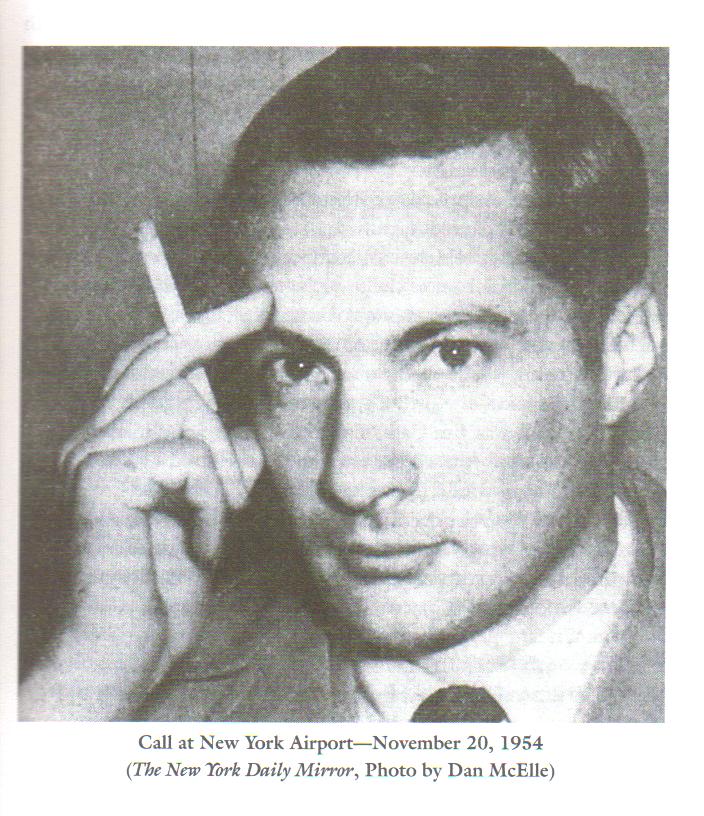
Holmes held up a book that I had retrieved from the 21st century — Tailspin, The Strange Case of Major Call[1]. “This book,” he exclaimed, “documents facts about Major James Arlon Call that address most of the physical evidence ignored by the Cleveland authorities!”
I felt his excitement build as he paced back and forth in front of his two lists. “Major George Warburton, a retired U.S. Air Force pilot, researched Major Call and reported his findings to author Bernard Conners. According to Warburton, Major Call became severely depressed after his wife’s death in 1952 and began writing bad checks in gambling casinos. In May 1954 he deserted Barksdale Air Force Base in Louisiana and went on to commit a series of burglaries, armed robberies and ever-escalating crimes in Ohio, Massachusetts and New York to support his gambling addiction and passion for hot cars and sports car racing.
“On June 5, 1954, he held up a liquor store in Hancock, Massachusetts, and beat the store’s owner on the head with his pistol. He broke in and stole items items from cabins and homes in New York during the months of July and August and ended up killing one policeman and wounding two others while burglarizing a cabin in Lake Placid, New York. On November 9, 1954, he was arrested once again.”
“Now hold on, Holmes,” I complained. “Call is obviously a bad character, but what has he got to do with the murder of Marilyn Sheppard?”
“Based on Major Call’s string of arrest warrants,” Holmes replied while scanning his notes,” Warburton was able to track Call’s movements from the time he deserted to the time he was arrested for murder of a police officer, except for 19 days from June 13 to July 5, when Call completely dropped out of sight. Warburton interviewed Call’s sister, who lived in Mantua, Ohio – about 30 miles south of Cleveland. She told him that Call had been staying with her in Mantua during those 19 days, and that he was away much of the time.”
“So, you’re suggesting that Call was in the Cleveland area when Marilyn Sheppard was murdered,” observed Dr. Kirk. “But what’s the connection?”
“Several important clues are reported in Tailspin, and most are confirmed via official police records,” Holmes responded. “When Major Call was arrested throughout his crime spreee, investigators found details that fit much of the physical evidence present at the Sheppard crime scene.”
Holmes stopped in front of List Two and struck the paper with the side of his hand as each item listed was mentioned. “Call smoked unfiltered cigarettes and always carried matches wrapped in aluminum foil. Call’s blood type is O with M factor. Furthermore, when apprehended by New York State Troopers on October 4, 1954, Call’s belongings included a red wool sports shirt; a blue wool sweater; blue cotton trousers with the ‘left leg torn full length up on the inside seam;’ a 12-inch crowbar with ‘particles of white and red paint adhering;’ and two tobacco pipes, one labeled Sterncrest Imported Briar — a highly coveted and expensive pipe popular in the 1940s and early 1950s.”
The two pipes were of great interest to Holmes. “The trooper report collected by Warburton stated, ‘teeth marks indicate that both pipes were used by the same person.’ Now I have to wonder,” added Holmes, pursing his lips and eyeing his own favorite pipe, “what would those investigators have found if they had compared those teeth marks with teeth marks on the pipes that remained on Sam Sheppard’s desk.”
I had been jotting notes on a tablet and looked up at Holmes’ remark. “They might have found a match, thus linking Call to the murder — which they would have promptly ignored,” I smirked. “But here’s what I want to know: Was Major Call left-handed and did he have a chipped tooth?”
“According to Warburton’s notes, Major Call was right-handed,” answered Holmes. “He doesn’t identify the source of that information, and he never mentioned a chipped tooth.”
“But let us remember,” interjected Dr. Kirk, “Call was in the military. In the 1950s left-handed soldiers, as well as school children, in America, were required to function with their right hands. However, researach has shown that under stressful or urgent conditions, a left-handed person will lose his adapted right-hand behavior and will unconsciously revert to his inate left-handed dominance. Thus, Major Call could very well have been the left-handed killer.”
“Supporting that conclusion,” noted Holmes, “when finger-printed on November 20, 1954, Call had a scar on his left index finger that had not been present on earlier fingerprints.”
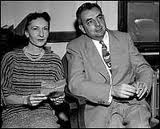
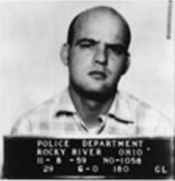
Dr. Kirk and I stared at Holmes for a moment. It was a lot to absorb. Undaunted, Holmes carefully placed a photo of Major Call on the table between two other photographs – one of Spencer and Esther Houk, and the other of Richard Eberling. “Now I ask you, gentlemen, how might these people be acquainted with one another, or might there be yet another partner in crime?”
Eager to answer Holmes’ query, I reported on my 20th-century sleuthing. “Richard Eberling, the Sheppard’s window washer, murdered his benefactress with the help of a close friend, Mr. Obie Henderson. He was indicted with Eberling for the 1984 murder of Mrs. Ethel Durkin. Eberling and his pal might have joined up in the murder of Mrs. Sheppard as well, but I could find no evidence that Mr. Henderson and Mr. Eberling were friends as far back as 1954.”
Dr. Kirk added, “Richard Eberling washed windows for many of the homeowners along Lake Road, so the Houks undoubtedly knew him. But I can fathom no reason for them to link up with him under these circumstances.”
“Nor can I,” agreed Holmes. “But remember, when you have eliminated the impossible, whatever remains, however improbable, must be the truth.”
[1] Conners, Bernard F. Tailspin, The Strange Case of Major Call. British American Publishing, Latham, New York, 2002.
Discover more from The Sheppard Chronicles
Subscribe to get the latest posts sent to your email.
